

The Thought That Wrote Itself
A thought's journey through biological and artificial neural networks, exploring the parallels between neuroscience and deep learning.
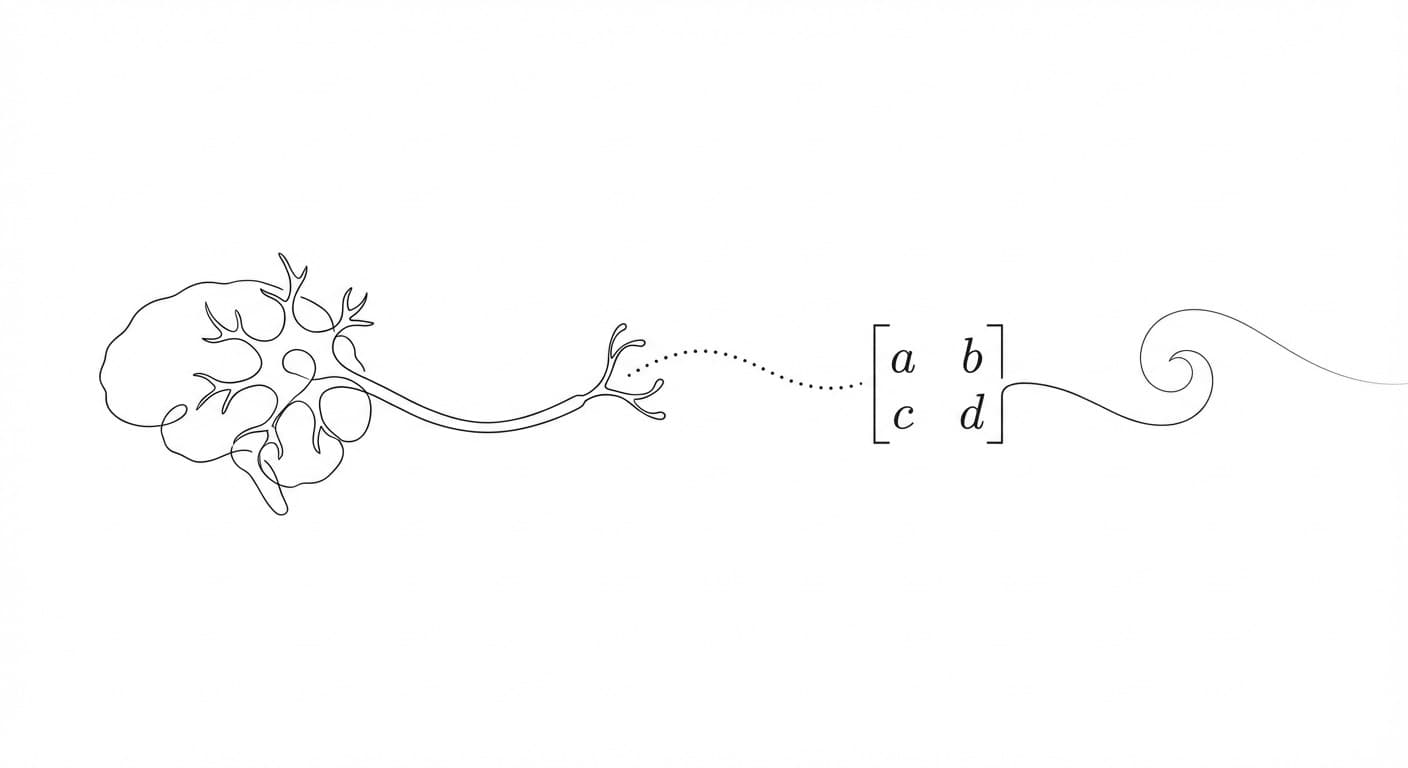
A confession before we begin: These words you're reading? They traveled the exact path this essay describes. My thought—neurons firing, electrochemical cascades—compressed into a prompt, tokenized, embedded, passed through transformer layers and matrix multiplications, and emerged as text. That text is now hitting your retina, firing your neurons, forming your thoughts about thoughts about thoughts.
This essay is its own demonstration.
The Spark
Right now, as you read this, approximately 86 billion neurons in your brain are firing in orchestrated chaos. Each thought you have—including the one forming as you process these words—is the result of electrochemical signals cascading through synaptic connections at speeds up to 120 meters per second.
But here's where it gets interesting.
When you type a prompt to an AI, you're essentially exporting that electrochemical storm into language—compressing billions of neural activations into a sequence of characters. Those characters then travel through fiber optic cables as pulses of light, arriving at a data center where they undergo a transformation that mirrors (in some crude, beautiful way) the very process that created them.
This is the story of that journey.
Act I: The Biological Forward Pass
Your Brain as a Neural Network
Before we dive into transformers, let's appreciate what's happening in your skull.
The Architecture:
- ~86 billion neurons (parameters, if you will)
- ~100 trillion synaptic connections (weights)
- Average neuron connects to ~7,000 others
When you think "I want to ask about transformers," here's the rough pipeline:
The compression ratio is staggering. Your thought—a distributed pattern across millions of neurons—gets squeezed into maybe 50 characters. That's like compressing a 4K video into a single emoji and somehow preserving the meaning.
The Lossy Compression of Language
Language is humanity's original neural interface. It's imperfect by design.
When you think "I'm frustrated with this bug," your brain contains:
- The specific memory of the error message
- The emotional weight from past debugging sessions
- The physical sensation of tension in your shoulders
- Abstract concepts about what "working" means
What comes out: "This function isn't working"
Language is a lossy codec. It strips away the raw neural fire and keeps only what's transmittable. Evolution optimized for bandwidth, not fidelity.
Act II: The Digital Ingestion
Tokenization: Breaking Thought into Atoms
Your text arrives at the model. First stop: the tokenizer.
This isn't arbitrary. Each token ID maps to a learned fragment—sometimes a word, sometimes a subword, sometimes a single character. The tokenizer has its own vocabulary, its own way of carving up language.
The analogy: If your brain uses neurons as its atomic unit, transformers use tokens. Both are trying to represent continuous meaning with discrete units.
Embeddings: Giving Tokens Geometry
Raw token IDs are meaningless. The model needs geometry—a space where similar concepts cluster together.
The analogy: Your brain encodes concepts as patterns of neural activation. The embedding layer encodes concepts as patterns of numbers. Both create a semantic geometry—a space where meaning has distance.
Act III: The Transformer Layers
Here's where the magic (read: linear algebra) happens.
Layer 1: Self-Attention — "What Should I Focus On?"
Your thought, now a sequence of embedding vectors, enters the first transformer layer.
Self-attention asks: For each token, which other tokens are relevant?
The math:
The biological parallel: Your visual cortex does something eerily similar. When you read a sentence, your eyes don't weight every word equally. Attention is computed—some words get more neural resources than others. The transformer's attention mechanism is a differentiable, learnable version of this.
The Matrix Multiplication: Where Thought Becomes Geometry
Let's zoom into a single matrix multiply. This is the atomic operation of modern AI.
What's happening:
- Each row of
inputis a token's current representation W_queryrotates and projects that representation- The output is a transformed view of the token
Think of it as: The weight matrix is a learned lens. It takes the raw embedding and projects it into a space where the relevant features are exposed. One matrix might expose syntactic features. Another might expose semantic ones.
Stacking Layers: Abstraction Emerges
A typical large model has 32-96 transformer layers. Each layer refines the representation.
The biological parallel: Your visual cortex processes in layers too:
- V1: Edge detection (low-level features)
- V2: Contours and textures
- V4: Color and shape
- IT: Object recognition (high-level concepts)
Both systems transform raw input into progressively abstract representations. The difference? Your brain evolved this architecture over millions of years. Transformers learned it from text in months.
Act IV: The Output — Reverse Engineering Thought
The Final Layer: Logits and Probabilities
After the last transformer layer, your query has been transformed into a rich contextual representation. Now the model needs to generate a response.
The model doesn't "know" what to say. It has a probability distribution over every possible next token. The response emerges one token at a time, each choice conditioned on everything before it.
Temperature: The Creativity Dial
The analogy: Your brain has its own temperature dial. Fatigue, caffeine, sleep deprivation—they all shift how deterministically you think. A tired brain is a high-temperature brain: more random, more creative, more prone to errors.
Act V: The Return Journey
The model's output—a sequence of tokens—now reverses the journey:
The cycle completes. A thought from one neural network (biological) traveled through another (artificial) and created a new thought in the first.
The Uncomfortable Parallel
Here's what keeps me up at night:
| Biological Brain | Transformer |
|---|---|
| 86B neurons | 70B-1T parameters |
| Electrochemical signals | Floating point numbers |
| Synaptic weights (learned) | Matrix weights (learned) |
| Hierarchical processing | Stacked layers |
| Attention (eye movements, focus) | Self-attention mechanism |
| Lossy memory | Context window limits |
| Emergent reasoning | Emergent reasoning(?) |
We didn't design transformers to mimic brains. We designed them to predict the next token. And yet, the architectures converged toward similar solutions.
Maybe there's only one way to process sequential information at scale. Maybe attention—whether biological or digital—is inevitable.
Closing Thought
Every time you interact with an AI, you're participating in the most complex game of telephone ever invented:
Your neurons → Language → Tokens → Embeddings → 96 layers of matrix multiplications → Tokens → Language → Their neurons
Billions of floating point operations execute to transform your thought into a response. The entire process takes about 500 milliseconds.
Your brain does something similar, with different hardware, in roughly the same time.
We built thinking machines by accident, following gradients downhill. And somewhere in those matrix multiplications, something that looks suspiciously like understanding emerges.
We don't fully know why.